Showing posts with label erastus dow palmer. Show all posts

Tuesday, August 12, 2014

Partial Collapse - The Palmer-Gavit House

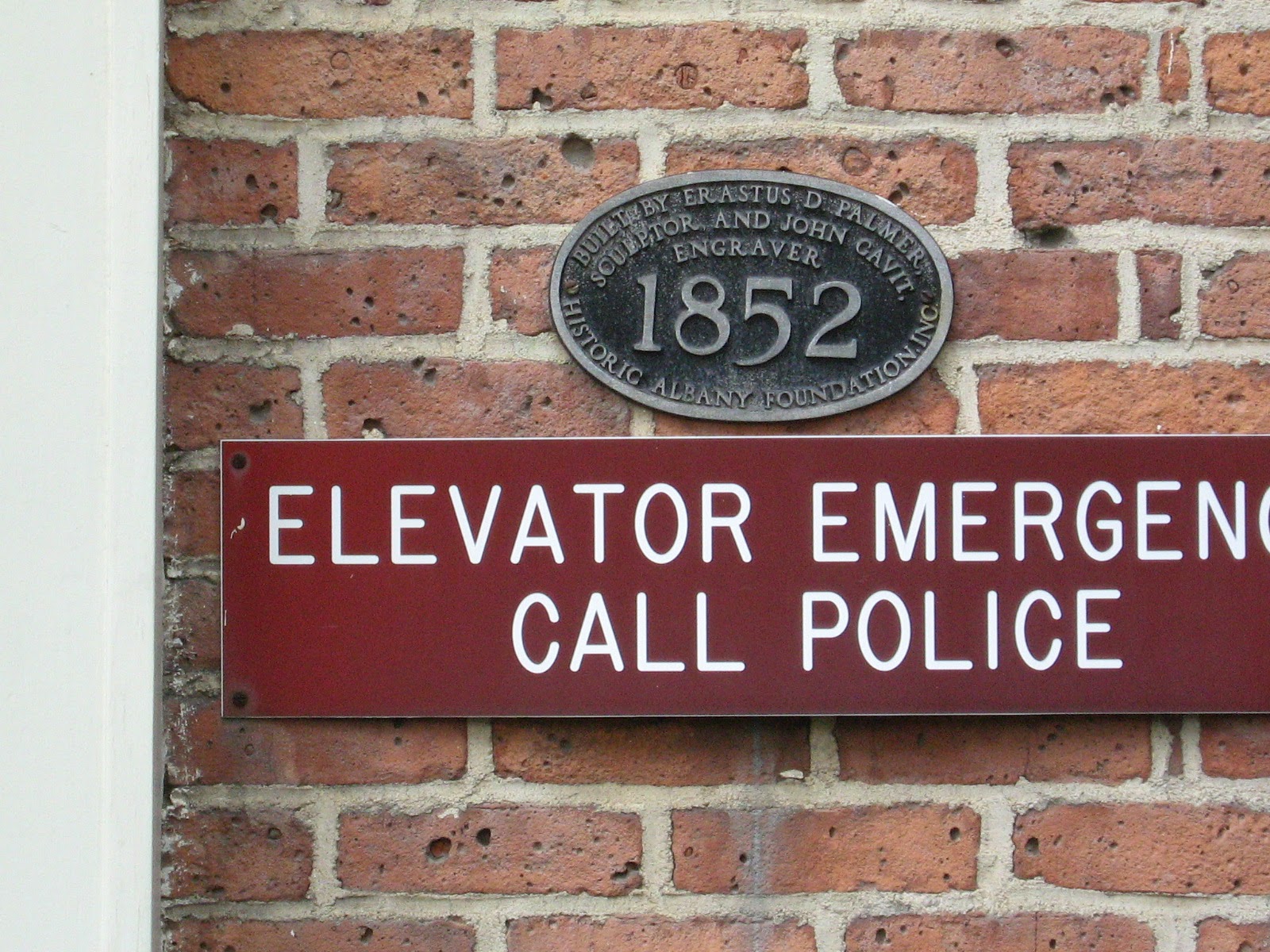
Yesterday afternoon, various local news outlets reported on the collapse of a building in downtown Albany.  The building is located on Columbia Place (a corner just north of the intersection of Eagle Street and Columbia Street).

The brick house was built in 1852 by sculptor Erastus Dow Palmer and John Gavit.  Gavit was a well-known Albany printer whose son, Joseph, would later marry Palmer's daughter Francis.  By 1860, the house was mentioned in a long, rather florid poem in celebration of Albany that was read at the dedication of Tweddle Hall.  One verse read in part: 

Our present, with that light upon us, how 
Moves on Majestic to new glories now.
Arts flourish, Progress laughs, and all the world
Begins to know our banner is unfurled.
Here Palmer first divulged his splendid gifts,
Till now the sceptre of high art he lifts --
Till now his native genius, power, and grace
Make an art Mecca of Columbia place.

(from "Dedidcation of Tweddle Hall," a poem delivered by William D. Morange, Esq.)

Palmer began his career as a self-taught sculptor in Utica, but relocated to Albany in 1846.  As a carpenter, Palmer had built mantles, carved moldings, and bannisters for various residences in Utica and it is possible that he did at least some of the interior woodwork for this new house in Albany.  The building adjacent on the right in the photos was built as Palmer's studio and it was here that many of his best known marbles were executed, including The White Captive, Peace In Bondage, and the heroic Angel At The Sepulchre.  Several other artists started their careers as apprentices in his studio, most notably Charles Caverley who sculpted the monument to Robert Burns in Washington Park.  According to one of Palmer's daughter's, the studio included a blacksmith and carpentry shop on its lower floors while the marble studio and modelling studio were located on upper floors.

Due to high city taxes, Palmer later changed his primary residence to Appledale, a farm he owned in Glenmont.  He continued to work from this studio and was a regular at Lawson Annesley's frame shop and art gallery.  He also owned a house at 5 Lafayette Street where he died on March 9, 1904. 

In the 1870s, Palmer's Columbia Place house was briefly occupied by St. Agnes School.  An advertisement for the school notes that it will be opening for its third year at 2 & 3 Columbia Place before moving to its permanent building later in the school year.  In more recent times, the building has been used for offices, but was vacant for several years as a photo posted on my companion blog in 2009 shows it empty and for sale.


At the time of yesterday's collapse, the building (which was recently sold) was undergoing stabilization.   The rear of the property sits atop the steep hill above Sheridan Hollow and it is possible that recent heavy rains which flooded the hollow below may have contributed to the damage.

As of this afternoon, news reports indicate that building will be stabilized and saved.

Thursday, January 10, 2013

Erastus Dow Palmer

Erastus Dow Palmer by Matthew Brady

On March 10, 1904, the New York Times published the obituary of Erastus Dow Palmer, referring to the long-time resident of Albany as "one of the pioneers of American sculpture."

He was born in Pompey, New York on April 2, 1817.  The son of a farmer, he learned to carve wood at an early age.  In addition to helping cut axe handles and other utilitarian tools, he also is said to have carved toy horses, windmills, and even made a little fiddle from a cigar box.

As a young man, he moved to East Aurora (near Buffalo) to work as a carpenter.  While living in East Aurora, he married, but illness claimed both his wife and infant son.  Shortly after this double loss, he relocated to Utica where he continued as a carpenter and woodcarver.  In 1843, he married Mary Jane Seaman.

Having seen illustrations of cameos in the home of a client, Palmer was inspired to cut a cameo of his wife using an oyster shell and the smallest of his carpentry tools.  He showed the finished piece to a local lawyer for whom Palmer had done work.  The lawyer was very impressed by Palmer's work and immediately lent him books with engravings of famous artwork, provided him with letters of recommendation to a number of prominent artists of the era, and strongly encouraged Palmer to pursue a career as a sculptor.

That career began with a series of portrait cameos, mainly of prominent Utica residents.  However, Palmer found that working on such a small scale was straining his eyesight.  He began producing larger reliefs in marble.  One early work is the allegory of Faith which hangs in St. Peter's Episcopal Church in downtown Albany and is shown below.

Faith at St. Peter's Episcopal Church

He would move from reliefs such as the Spirit's Flight (shown below) and a haunting image of the poet Sappho to busts (including likenesses of Washington Irving, Erastus Corning, and Henry Burden) and, eventually full length-statues such as the White Captive and The Indian Girl.  Later in his career, he produced sculptures in bronze such as the bust of Doctor James Armsby in Washington Park and the statue of Robert Livingston in the U.S. Capitol's Statuary Hall (with a copy in New York State Capitol.)


Early his career, Palmer relocated to Albany, a larger city that would provide him with many opportunities for commissions.  His home and studio still stand just north of City Hall on Columbia Place.  He later moved to nearby Lafayette Street (since demolished to make way for the park of the same name) and to a farm in Glenmont which he named Appledale.  He maintained close friendships with a number of contemporary artists including Frederick Church (a pair of reliefs by Palmer hang at Church's Olana) and Asa Twitchell.  Palmer would often spend time with the latter at Lawson Annesley's gallery and art store on North Pearl Street.

Palmer died at the age of eighty-six on March 9, 1904 and was buried in the Albany Rural Cemetery.

A number of Palmer's works are on display in a permanent gallery at the Albany Institute of History & Art.  This exhibit includes the previously mentioned Sappho, Peace In Bondage (an allegory created during the Civil War), First Sorrow (a full length-figure of a little girl holding an empty nest), as well as plaster casts of the Indian Girl and The White Captive (the original pair of marbles is on display at the Metropolitan Museum of Art).  The centerpiece of the AIHA exhibit is the plaster cast of his masterpiece, the Angel At The SepulchreA vivid portrait of Palmer by Charles Loring Elliott is also on display, as well as a painting of Palmer at work in his studio, surrounded by apprentices (including Charles Caverley) and many recognizable works.

The Angel At The Sepulchre

The Angel is one of ten monuments Palmer created for the Albany Rural Cemetery, including Grief, Remembrance, portrait medallions of Thomas Olcott, Lewis Benedict, and Benjamin Knower, as well as the granite headstone of Governor William Marcy.  A pair of reliefs representing Morning and Evening were incorporated into Palmer's own monument by architect Marcus T. Reynolds.

Grave of Erastus Palmer at the Albany Rural Cemetery