Wednesday, March 14, 2018

Or did Burr shoot Aaron?


A rather amusing piece from Times Union on August 4, 1936. 

Historic Albany:

'Aaron Shot Burr On Albany Corner”

Touring Reporter Gets Startling Angles on City

By Tourist

Leaving gun and camera at home, the touring reporter stalked through historic old Albany yesterday, armed with pencil and paper to bag a compiled report on how much Albanians actually know about their city.

Thursday, October 12, 2017

Restoration Work Needed At Albany Rural Cemetery


“At the west, a short distance below, is a pear-shaped bit of silver, known as Cypress Water, in which is  a miniature island.”

(from "The Albany Hand-book for 1881" by Henry Pitt Phelps)

One of the most recognizable features of the Cemetery landscape, Cypress Pond (or Cypress Waters, as it was more commonly known in the past) turns 148 years old this year.  Among the monuments that overlook this pretty "bit of silver" are the bronze statue of "Contemplation" by Charles Calverley atop the grave of Dr. Jephta Bouleware, the pensive maiden marking the family plot of author Charles Fort, and one of the most photographed statues at Albany Rural - the John G. Myers angel.  Seven of the Cemetery's many roads and paths converge here.

The centerpiece of the South Ridge, if not the entire Rural Cemetery, Cypress Pond was created from a swampy patch of land dotted with natural springs.  A large stone slab covering the outlet at the north end of the pond bears the date of its creation, 1869.  The work was undertaken during the tenure of Superintendent J.P. Thomas who was known for numerous changes and improvements to the Cemetery, including the extension of the grounds to the South Gate.  While a small pond does appear on Cemetery maps from the late 1850s, this area of the Cemetery was, for the most part, a swampy area dotted with natural springs.

And what's in a name? The cypress is a tree long associated with cemeteries and can be found growing in many burying grounds. It has been a symbol of mourning since ancient times because, if cut back too much, the tree will not regrow. Its branches were gifted to grieving families in Athens and it was burned to clear the harsh odors of cremations. The trees have also been planted in great numbers in Turkish cemeteries for centuries

Early photos of Cypress Waters show the little island which formerly occupied the middle of the pond.  Some of the earliest views even show a little canoe near the island.  The wooded island was later replaced with a classically-styled fountain installed in 1950.

Unfortunately, Cypress Pond is now in urgent need of repair.  The fountain which replaced the little island has not functioned in several years.  Several sinkholes near the newly repaired shelter at the northeast corner of the pond required work.  The pond walls are unstable and tilting inward towards the water.

Work is being done in phases and, to date, the Cemetery has financed $21,115 towards these much needed repairs.  The final two phases of the project - replacement and reactivation of the fountain and the stabilization of the pond walls will require additional funds.

The fountain runs on water pressure from a gravity-fed reservoir.  It will be converted to an electrical source with a new floating aerating fountain similar to those seen in Washington Park, Buckingham Pond, and The Crossings in Colonie.  The work will included electricity and working water outlets in the areas around the pond.  The engineering work and design are completed and the project is now awaiting funding.

The buckling pond walls are hazardous, especially since the area immediately around the pond is a popular place for visitors to park and walk.

A more detailed illustrated report on the work to be done and funds needed can be downloaded here:  Cypress Pond Restoration Report PDF

If you would like to make a donation of any size to help complete the badly-needed repairs to the fountain and pond walls, please make a check or money order out to:

Albany Rural Cemetery
Cemetery Avenue
Menands, New York 12204

Please include a memo that the donation is for "Restoration of The Cypress Pond Area."  Or contact the Cemetery directly at  518-463-7017 or albanyruralcemetery@biznycap.rr.com with any questions or to discuss other donation options.  You can also stop by the office during business hours.  Donations are tax-deductible.

And, please, share and spread the word.  This post (with additional historic images of the pond) will also be available on Facebook at Albany Rural Cemetery - Beyond Graves (it will be pinned to make it easy to find) and on Twitter.

Sunday, December 18, 2016

James' Cancer Fight


As those of you who follow either my personal Facebook profile, my Albany Rural Cemetery Facebook page, or Twitter account might know, my partner of eight years has recently been diagnosed with throat cancer and, last week, underwent a temporary tracheostomy to relieve serious breathing problems that occurred as a side effect of the radiation treatments.

I affectionately refer to James as my research assistant though his assistance generally consists of carrying my backpack full of maps and notes, asking if it's time to go home for lunch, or making sure I don't tumble down various hills while taking photos at Albany Rural.

His cancer is in the early stages and, even with setback due to the breathing complications, his prognosis is good.  But this is still an incredibly difficult time for us.  I am acting as his full-time caregiver until he completes his treatments and completely recovers.

More can be read at our GoFundMe page.  If you can contribute or even just share the link, it would be truly appreciated.

James' Cancer Fight on GoFundMe

Thank you and Happy Holidays.

Paula

P.S.  I will post some updates regarding the preservation of the Church of the Holy Innocents as time allows.

Sunday, December 20, 2015

Help the Albany Rural Cemetery


The history of the Albany Rural Cemetery is closely interlaced with Albany's history.  If you'd like to support the Cemetery, please see the link below for a list of ways (including the Annual Fund, membership in the Friends of the Albany Rural Cemetery, and volunteering).

Support Albany Rural Cemetery

"Over the years, many generous donors have made tax-deductible gifts to the cemetery and such support is needed now, more than ever. For the sake of “these exalted acres” and the many people who enjoy the parklike setting, a historic resource in the upper Hudson Valley, we hope to broaden our base of support." 

- from a letter to the Times Union by Frank Slingerland, President of the Board of Trustees.

And, if you enjoy the Cemetery's history, don't forget to like this page on Facebook:

Albany Rural Cemetery - Beyond The Graves

Thursday, November 12, 2015

Saturday, October 24, 2015

The Grim Past of Van Rensselaer Park

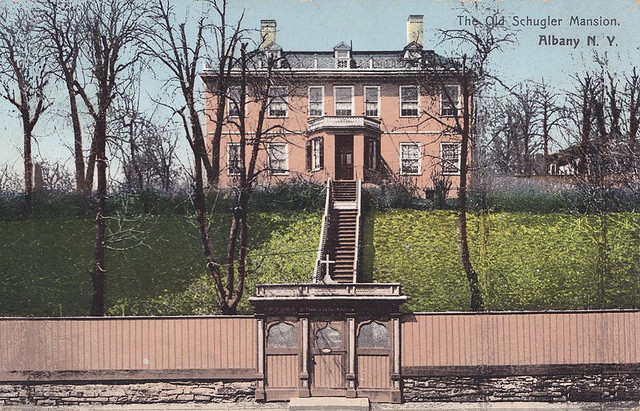
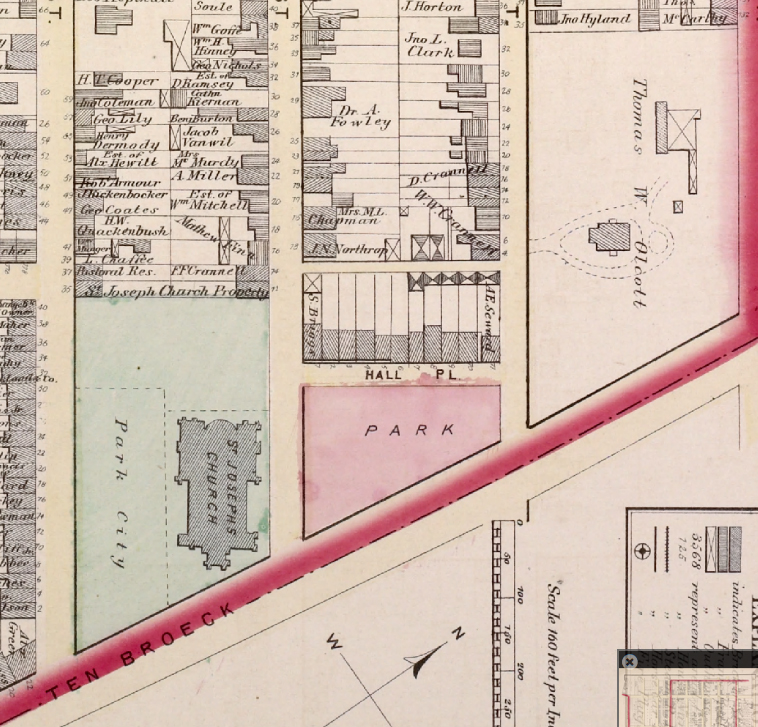
Located between the vacant St. Joseph's Church and the Ten Broeck Mansion (identified on the 1876 map below as the property of Thomas W. Olcott), Van Rensselaer Park is a small and pretty wedge of urban greenspace.

Framed by Ten Broeck Street, Ten Broeck Place, Hall Place, and Second Street, it features a modern playground and an elegant 19th-century iron fence.  Its history, however, goes back to the mid-18th century and the Patroons of Rensselaerwyck.

On October 31 1764, Stephen Van Rensselaer II deeded this parcel of land to the City of Albany specifically for the purpose of a cemetery.  At the time, this area was known as "The Colonie," though by 1808 it was annexed to the city proper.

Known variously over the years as the Colonie Burial Ground, the Arbor Hill Burial Ground, and the Van Rensselaer Burial Ground, the Patroon intended that the lot be used held by the city "on the condition that the same should not be applied to any private purpose or secular use, but should remain as a burial ground or cemetery for all persons in the manor of Rensselaerwyck."

The Van Rensselaer Burial Ground is not to be confused with the private vault which was later built on the grounds of the Van Rensselaer Manor House for the interment of the Patroon's own family and which was later torn down in favor of a large plot at the Albany Rural Cemetery.


As with the municipal State Street Burying Grounds at the western edge of the city, the little Arbor Hill Burial Ground eventually became an eyesore.  The streets around it were filling up with elegant new houses.  Construction and improvements to the surrounding streets altered the grade of the land around the old cemetery.  Removal of the surrounding soil raised the burial grounds edges to an embankment of some fifteen feet.  Bones and coffins were often exposed as sand was removed. Sometimes the remains tumbled into adjacent lots. The surrounding wooden fence was in ruins.

The well-to-do residents of Ten Broeck Triangle were not pleased to see gloomy old tombstones and exposed remains from their windows and stoops.  Local property owners, including Joseph Hall (the namesake of Hall Place), advocated for its removal.  

An 1844 report to the Common Council observed:

"The whole presents a neglected and ruinous aspect, which must be painful to the surviving friends of the dead, who are buried there, and a source of annoyance to a neighborhood daily becoming more populous, notwithstanding the obstacle to its growth which this burying ground presents.....would not be expedient to continue to use this ground for future interments. The public are becoming every day more convinced of the inconveniences and painful associations, as well as the unhealthiness of burying the dead in the midst of the habitations of the living, and it is to be hoped that the practice with us, as it is in very many cities, will be entirely discontinued. Apart from the other considerations, this ground, after all that may be done for its improvement, will still present an appearance of insecurity, which must deter most persons from allowing their friends to be buried in it. We are, however, bound to protect the remains of those who now lie there, and the question presents itself whether it is better to put the ground in as decent condition as possible, or to remove the remains to a proper place where they may remain undisturbed in future."

One expensive proposed remedy was a new fence of varying heights to enclose the forlorn graveyard.  Another proposal called for removing the old remains to a lot at the new Rural Cemetery and erecting a suitable monument over them.

We propose then, in place of maintaining at a heavy expense to the city the present unsightly burying ground on Arbor Hill, that the remains of those buried there should be carefully removed to the new cemetery and then deposited in a vault over which a handsome monument shall be erected – on the monument the names of dead may be inscribed and it will thus stand as a perpetual memorial. Neither the growth of the city or any probable contingency will ever disturb the remains there deposited – survivors will no longer be shocked by seeing the bones of their relatives bleaching in the sun, but will feel a comfort and joy in seeing the place of their repose surrounded as it will be by the most appropriate associations, and their own pathway to the grave may be made more cheerful by the thought that the same resting place may at the appointed time receive their own remains, as well as those of their friends.
 
In the end, neither plan was adopted.  On October 1, 1849, Stephen Van Rensselaer III deeded the land to the city again.  Now that the city held title to the land without the stipulation that it be used for burials, work began to clear the graves and transform the old boneyard into a small park (just two decades later, the State Street Burying Grounds would similarly be converted to Washington Park)

Relatives of the deceased at were given a chance to remove the bodies of their kin from the Arbor Hill Burial Grounds at their own expense;  a few were indeed transferred to the Rural Cemetery.  The rest would be disposed of by the city.  According to a 1901 column in the Albany Evening Journal:

A large underground vault was placed in the center of the plot and all bodies not claimed were put in the common vault and the spot covered.  The bones, or what remains of them, are now reposing within the confines of the park.

The articles and records make little or no mention of what became of the old headstones.  They might have been stacked inside the vault, recycled for paving and other purposes, or simply discarded.
 

Wednesday, October 21, 2015

Sunday, September 27, 2015

The Albany History Race

Yesterday was the second Albany History Race courtesy of the Albany Public Library.  Thanks to Christopher and Paul for taking part as Team Assiduity.

Finding Your Past - Albany History Race 2015

Wednesday, August 12, 2015

Everything Old Albany On Flickr

 For an extensive collection of Albany photos - ranging from long-demolished buildings to vintage advertisements (and everything in between), visit the Albany...The Way It Was group archive on Flickr.

Thousands of photographs are sorted into albums by topic (such as Civil War, Washington Park, Banks, Maps, and more).  It's a treasury worth exploring.

Also, for terrific discussions on Albany history, please consider joining the Facebook group.

Friday, May 15, 2015

Henry Johnson To Receive Medal of Honor

The long effort to posthumously award Henry Johnson the Medal of Honor for his service in World War I has been successful. 

Article from All Over Albany

Tuesday, May 5, 2015

Seriously Endangered Church of The Holy Innocents


In 1850, Albany lumber baron William H. DeWitt built a memorial to four of his children who died quite young.  In addition to a splendid marble tombstone in the Albany Rural Cemetery, DeWitt also erected a little stone church in their memory; the Church of the Holy Innocents.

Built at the corner of North Pearl and Colonie Streets, it was a short walk from the DeWitt home to the church which was designed by Frank Wills.  In the 1860s, a matching chapel was added to the south side; this addition designed by Edward Ogden and William L. Woolett.

Holy Innocents served as an Episcopal church until the late 1940s.  Until 1980, it was home to a Russian Orthodox congregation (hence the distinctive blue "onion dome" which replaced the original steeple and bell around 1960.

Vacant since 1980 and currently owned by Hope House, this beautiful building has suffered greatly from neglect.  It is listed on the National Register of Historic Places and cited by the Historic Albany Foundation as one of the city's most endangered buildings, it is also one of the oldest church structures in Albany.  
 

Yesterday, the rear wall of the church collapsed.  Despite the damage and the decades of neglect, Historic Albany Foundation states that the building can be stabilized and saved.

Albany is one of the oldest and most historic cities in the United States, but much of our tangible history has been lost to neglect and demolition.  Several years ago, the equally historic Trinity Church was demolished after part of the structure caved in. 

Please, let's not lose the Church of The Holy Innocents, too.  Call the City of Albany and let them know this historic church must be stabilized and saved, not reduced to yet another empty lot and yet another empty hole in the city's cultural and historic fabric.

Office of The Mayor, City of Albany - 518-434-5100
Hope House (current owners of the site) - 518-482-4673 - Kevin Connally, Executive Director


Photos are from the Albany...The Way It Was collection on Flickr

Albany...The Way It Was Facebook Group
Albany...The Way It Was on Flickr

Times Union article

Sunday, January 11, 2015

The Step Stone of The Church


Volume One of Joel Munsell's Annals of Albany contains a description of an old stone which marked the location of the First Dutch Church on Broadway near the foot of State Street.  The stone survived until 1850.  The stone - or at least an artistic rendering of it - is the kidney-shaped object near the left side of the "very rude engraving" above (click to enlarge).

Friday, December 5, 2014

The Virginia Bowers Memorial Sculpture

This wonderful sculpture made from original trolley tracks removed from Delaware Avenue honors the late Virginia Bowers, Albany historian.  It's a whimsical creation with metal birds in its branches and stands behind the Delaware Avenue branch of the Albany Public Library.  If you'd like to buy a brick to be placed around the sculpture, they are $50 each and can be ordered here.

For more on Virginia Bowers, see this brief profile.

Saturday, November 8, 2014

An Uncommon Thrill - When The Hilton Sisters Came To Albany

Violet and Daisy Hilton

 In 1934, Daisy and Violet Hilton brought their vaudeville act to Albany.

Audiences at the Capitol Theater in Albany are getting an uncommon thrill these days, "The Hilton Sisters," American Siamese Twins," born at San Antonio, Texas, are appearing on the stage with their "Double Rhythm Revue" and are also meeting with the audience personally in the foyer to chat with patrons and present their autographs.

The Hilton Sisters, who are making an unfortunate accident of birth pay them back what it can by their stage appearances are also good entertainers.  They sing, play musical instruments and dance with male partners.


The June 4 edition of the Schenectady Gazette didn't get it quite right.  Daisy and Violet Hilton were not born in San Antonio, but in Brighton, England on February 5, 1908.  The illegitimate daughters of an unwed barmaid, the infant girls were fused together at the pelvis and, while they did not share any major organs, they did share a circulatory system and it was thought at the time that surgical separation could cause one or both girls to bleed to death.  Immediately after their birth, the twins were taken by their mother's boss, Mary Hilton.  Mary Hilton and her husband (always referred to as "Sir") raised the girls with plans to exploit their connection for profit.  They oversaw the girls' early training as singers and dancers, but kept them under control with threats and abuse.  The girls began their show business careers at the age of three when Mary Hilton and Sir took them on tour through Germany, Australia, and the United States.  Mrs. Hilton died in Birmingham and left control of Daisy and Violet to Mary Myers.  Mrs Myers took them to San Antonio and continued the girls' musical training.  The abusive control of every aspect of the twins' lives also continued until 1931 when the twenty-one year old sisters sued their "managers."  They succeeded in their suit, gaining their freedom from Mary Myers and her husband along with $100,000 in compensation.

 Advertisements like this appeared in the Albany, Troy, and Schenectady newspapers.

The Hilton Sisters took charge of their own careers, touring the country with a vaudeville act.  In 1934, their "Double Rhythm Revue" came to Albany.

Thursday, October 30, 2014

A Tour of Lost Cemeteries


Just in time for Halloween, All Over Albany (a site you should be reading daily) gave this blog a much appreciated shout-out in a post about Washington Park's previous incarnation as the State Street Burying Grounds.  

Below is a brief tour of sorts of some other former burial grounds in Albany.  It appeared in Charles Mooney's column (always a source of fascinating bits and pieces of local history) in the Knickerbocker News on October 14, 1961.

We ran across John E. Boos this week and, as we customarily do, asked Albany's famed authority on Abraham Lincoln if he had a story to tell. Mr. Boos, who is a man of a few thousand words when occasion demands, took a deep breath and said, to wit:

“Your column has been filled so much with butchers, and bakers, and candlestick makers, old buildings, old people, and Otto de Heus's sheet music, why not change to a more solemn subject and asked if the average citizen remembers or ever heard of the many cemeteries in the city?”

“There was a cemetery on Arbor Hill bounded by Ten Broeck Street, Second Street, Hall Place and Ten Broeck Place – now, and for many years a fenced-in lawn, although it could have been a more useful place as a neighborhood playground.

The Ten Broeck family erected a vault at Livingston Avenue and Swan Street in which was entombed the remains of Generals Philip Schuyler and Abraham Ten Broeck, both heroes of the Battle of Saratoga.

“When the vault began to crumble, the remains were removed to Albany Rural Cemetery, and General Ten Broeck's grave has never been marked, though there is a monument honoring him on the battlefield.

“To honor Col. John Mills and Gen. Solomon Van Rensselaer, they were buried near the Washington Avenue side of Capitol Park, one having been killed at Sackets Harbor in the War of 1812 and the other severely wounded at Queenstown Heights in the same war. Their remains were later removed to Rural Cemetery where they now rest, the state having erected a monument on Mills' resting place.

“At the foot of State Street, under the floor of the Reformed Church, a number of members were buried. The remains were removed in 1818 to a new cemetery on Beaver Street where a new church had been erected. (The National Commercial Bank's Heartland Building now covers the site).

“Peter Schuyler, Albany's first mayor, was buried in the church, and possibly his remains still rest in the Beaver Street plot.

“There was a cemetery on the south side of Central Avenue above Watervliet Avenue, where I believe the members of St. John's Lutheran Church were buried. There was another Lutheran cemetery on the State Street side of Washington Park at Willett Street, the bodies having been removed when the park was laid out.

“On Washington Avenue above Partridge Street was St. Mary's Cemetery, overgrown with weeds and brush when the bodies were removed to a new resting place in St. Agnes Cemetery, while at Hamilton and South Pearl Streets the Hallenbeck family'sburial plot covered a half acres for more than 100 years.”

John Boos, although he didn't say so in so many words, appears to regret some of Albany's old cemeteries were removed to make way for civic and industrial progress, for he added:

“The graves of early citizens are highly revered in Boston, and one who rambles down its crooked streets will still find the old cemeteries in the business section of the city. Kings Chapel, Granary and Old North Church have visitors from all over the nation who delight in reading the quaint inscriptions on the tombstones.”

Saturday, October 11, 2014

The Half Moon Sailing Away

Albany has a pretty poor record when it comes to keeping and promoting its history.  Now, there is a good chance that we will lose the Half Moon, the beautiful replica of Henry Hudson's ship which explored this area in 1609.

Replica Half Moon May Move To The Netherlands

It would be a wonderful thing if people could rally around keeping the ship here.  Otherwise, the only Half Moon that we will have left will be the historic weather-vane atop the old D&H Building on Broadway.

For more information on the ship and its activities...or to make a donation...please see their site:

The Half Moon

See also:  Helping History

Wednesday, October 8, 2014

Not The Right Stones


The Lake House is Washington Park has a series of panels which illustrate the Park's history.  They're generally excellent, include a number of vintage photos and maps, and are definitely worth stepping inside to view.

The panel which interests me the most is, not surprisingly, the one which notes the history of the Park's location as a municipal cemetery.  The State Street Burying Grounds served as the not-so-final resting place for thousands of local residents until it closed in 1868 and the remains moved to the Church Grounds section at the Albany Rural Cemetery.

The panel in question includes a detail of an antique map of Albany showing the position of the Burying Grounds and its divisions among various congregations.  Two headstones are included as representing the various graves at the Burying Grounds and therein lies an inaccuracy.


It is very unlikely that either gravestone shown on the panel was ever in the State Street Burying Grounds.

The upper stone shown on the right is one of the most distinctive gravestones in the Church Grounds.  Though it has eroded badly in recent years, it is an incredible example of a colonial headstone carved with a winged skull;  an "momento mori" intended to remind the living of their own eventual death.  The inscription is framed with heavy vines and the lettering is finely carved.  It was carved for the grave of Elyse Gansevoort Winne who died in 1728 and was laid to rest in the graveyard of the Dutch Reformed Church which was then on South Pearl Street near Hudson Avenue. When that graveyard was eventually removed, a number of its oldest stones and remains were placed in a special vault beneath the tower of the Middle Dutch Church which was erected nearby on South Pearl Street.  These same headstones and remains were later placed in a vault beneath the Madison Avenue Reformed Church, as noted in this article by John Walcott.  Those stones and remains  - including Elyse Winne's - were eventually placed in the Church Grounds at the Albany Rural Cemetery, but did not spend time in the State Street Burying Grounds and was therefore not included in the Common Council inventory of the Burying Grounds.


The lower stone depicted is a plain brown sandstone marker from the grave of Dick who is identified in the inscription as a slave of John F. Pruyn who died in 1799.  This stone now rests in the African Methodist Episcopal section of the Church Grounds.  Dick may or may not have been originally buried in the State Street Burying Grounds.  He does not appear in the massive list of graves inventoried by the Albany Common Council prior to the removal to the Rural Cemetery.  However, that list is not complete.  There are quite a few graves now in the Church Grounds that were not printed in the inventory, perhaps omitted by mistake as the stones were transcribed.  He may have originally been buried in the previous municipal cemetery which stood just off Eagle Street south of the State Capitol.  This cemetery received burials from around 1789 to 1799, the same year Dick died.  He may have been buried in one of the small graveyards identified on period maps as "Negro Burying Grounds".


Or it's very possible the young man was buried in the same graveyard as Elyse Winne.  Dick's master was a member of the Dutch Reformed Church and may have arranged for Dick to be interred in a family plot in the congregation's churchyard.  This would account for why Dick's name also does not appear on Common Council inventory.  Like Elyse Winne, Dick and his gravestone would have lain in the vault beneath the Madison Avenue Reformed Church before being eventually brought to the Rural Cemetery.

In that case, neither stone is representative of the graves cleared from the State Street Burying Grounds.  Also, the caption identifies the skull stone as belonging to Elyse Wenne Huys.  The word "huys" is not part of her surname, but part of the old phrase "huys vrouw" or "housewife."

See also:  Jeremiah Field and The Headstone That Was Not Lost, The Oldest Stones (includes a larger photo of the Elyse Winne stone),and Dick.

Wednesday, September 17, 2014

4 Elk Street

There's been some discussion of the Roosevelts in Albany, thanks to Ken Burns' new PBS documentary.

The elegant house above is 4 Elk Street which was home to Franklin Delano Roosevelt while serving as a State Senator from 1910-12.

The house was built circa 1830.  For many years, it was the home of Franklin Townsend .  In 1900, the facade was remodeled by architect Marcus T. Reynolds.  It was at this time that the lovely glazed panels were added above the third story windows;  the center panel depicts a classical female head above laurels and the side panels feature quivers of arrows and bows.

This is one of several facades that were incorporated into the present New York Bar Association Center building.