
Following up on a post from several months ago, there is a chance to save the beautiful, but seriously endangered Church of the Holy Innocents. For more information, please see this link:
Redevelopment Listing For Holy Innocents
Showing posts with label historic buildings. Show all posts
Showing posts with label historic buildings. Show all posts
Thursday, November 12, 2015


Tuesday, August 12, 2014
Partial Collapse - The Palmer-Gavit House

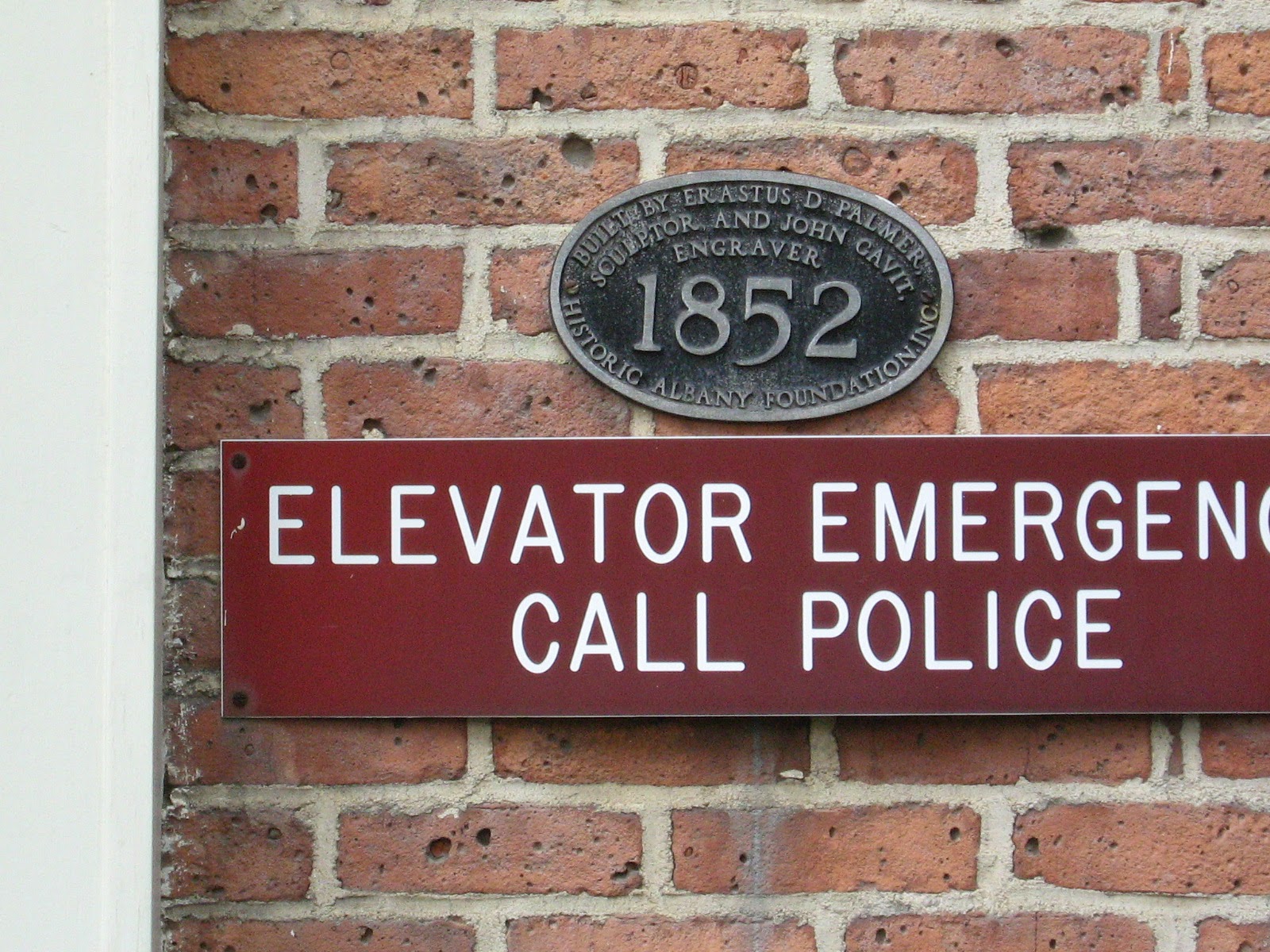
The brick house was built in 1852 by sculptor Erastus Dow Palmer and John Gavit. Gavit was a well-known Albany printer whose son, Joseph, would later marry Palmer's daughter Francis. By 1860, the house was mentioned in a long, rather florid poem in celebration of Albany that was read at the dedication of Tweddle Hall. One verse read in part:
Our present, with that light upon us, how
Moves on Majestic to new glories now.
Arts flourish, Progress laughs, and all the world
Begins to know our banner is unfurled.
Here Palmer first divulged his splendid gifts,
Till now the sceptre of high art he lifts --
Till now his native genius, power, and grace
Make an art Mecca of Columbia place.
(from "Dedidcation of Tweddle Hall," a poem delivered by William D. Morange, Esq.)
Palmer began his career as a self-taught sculptor in Utica, but relocated to Albany in 1846. As a carpenter, Palmer had built mantles, carved moldings, and bannisters for various residences in Utica and it is possible that he did at least some of the interior woodwork for this new house in Albany. The building adjacent on the right in the photos was built as Palmer's studio and it was here that many of his best known marbles were executed, including The White Captive, Peace In Bondage, and the heroic Angel At The Sepulchre. Several other artists started their careers as apprentices in his studio, most notably Charles Caverley who sculpted the monument to Robert Burns in Washington Park. According to one of Palmer's daughter's, the studio included a blacksmith and carpentry shop on its lower floors while the marble studio and modelling studio were located on upper floors.
Due to high city taxes, Palmer later changed his primary residence to Appledale, a farm he owned in Glenmont. He continued to work from this studio and was a regular at Lawson Annesley's frame shop and art gallery. He also owned a house at 5 Lafayette Street where he died on March 9, 1904.
In the 1870s, Palmer's Columbia Place house was briefly occupied by St. Agnes School. An advertisement for the school notes that it will be opening for its third year at 2 & 3 Columbia Place before moving to its permanent building later in the school year. In more recent times, the building has been used for offices, but was vacant for several years as a photo posted on my companion blog in 2009 shows it empty and for sale.

At the time of yesterday's collapse, the building (which was recently sold) was undergoing stabilization. The rear of the property sits atop the steep hill above Sheridan Hollow and it is possible that recent heavy rains which flooded the hollow below may have contributed to the damage.
As of this afternoon, news reports indicate that building will be stabilized and saved.
Thursday, August 8, 2013
The Clark Tavern

This rubble, photographed on August 6, is the last remnant of the 18th-century Clark Tavern which stood at the corner of Madison Avenue and Lark Street until late last week.
The Tavern was built by Paul Clark around 1796. Paul was the son of Patrick Clark and seems to have established his tavern around the time of his father's death. He had previously lived in what is now the Bushwick area of Brooklyn and returned to Albany when he inherited property from his father, including this lot. At the time, there was little or no development in this part of Albany. Madison Avenue appears on contemporary maps as Wolf Street and would be known as Lydius Street before receiving its current name. He also expanded his interests to include orchards which were best known for apple trees and was a founding member of Albany's Horticultural Society.
Upon his own death in 1831, his tavern was described as "famous" in works such as Joel Munsell's Annals of Albany. He was buried in the State Street Burying Grounds which were located just northwest of his property in present-day Washington Park and later removed to the Church Grounds at Albany Rural Cemetery. His gravestone is featured here.
Over the years, it was occupied by various businesses, most notably a pharmacy which remained until the 1970s. In more recent years, it was home to the Tandoori Palace. Damaged by a severe storm in 1950, it eventually lost its upper stories and its brick walls were covered with a thick painted plaster. It was not even included in the excellent guide to local buildings, Albany Architecture edited by Diana S. Waite. The Clark Tavern was, in a sense, lost long before demolition began late last week
I can remember the pharmacy quite well from my childhood, but despite living doors away for my entire life and being very interested in historic places, I was never aware of the actual age of this familiar building until this summer. Which is not to say I didn't suspect the building of being a little older than it appeared with its wrought-iron wall-ties that seemed at odds with the ugly plaster. During Art On Lark, I was handed a small flier about the building by a man I later recognized as John Wolcott, an advocate of historic preservation.
A new building is planned for the corner of Madison and Lark which will include residential and retail units.
Subscribe to:
Posts (Atom)


